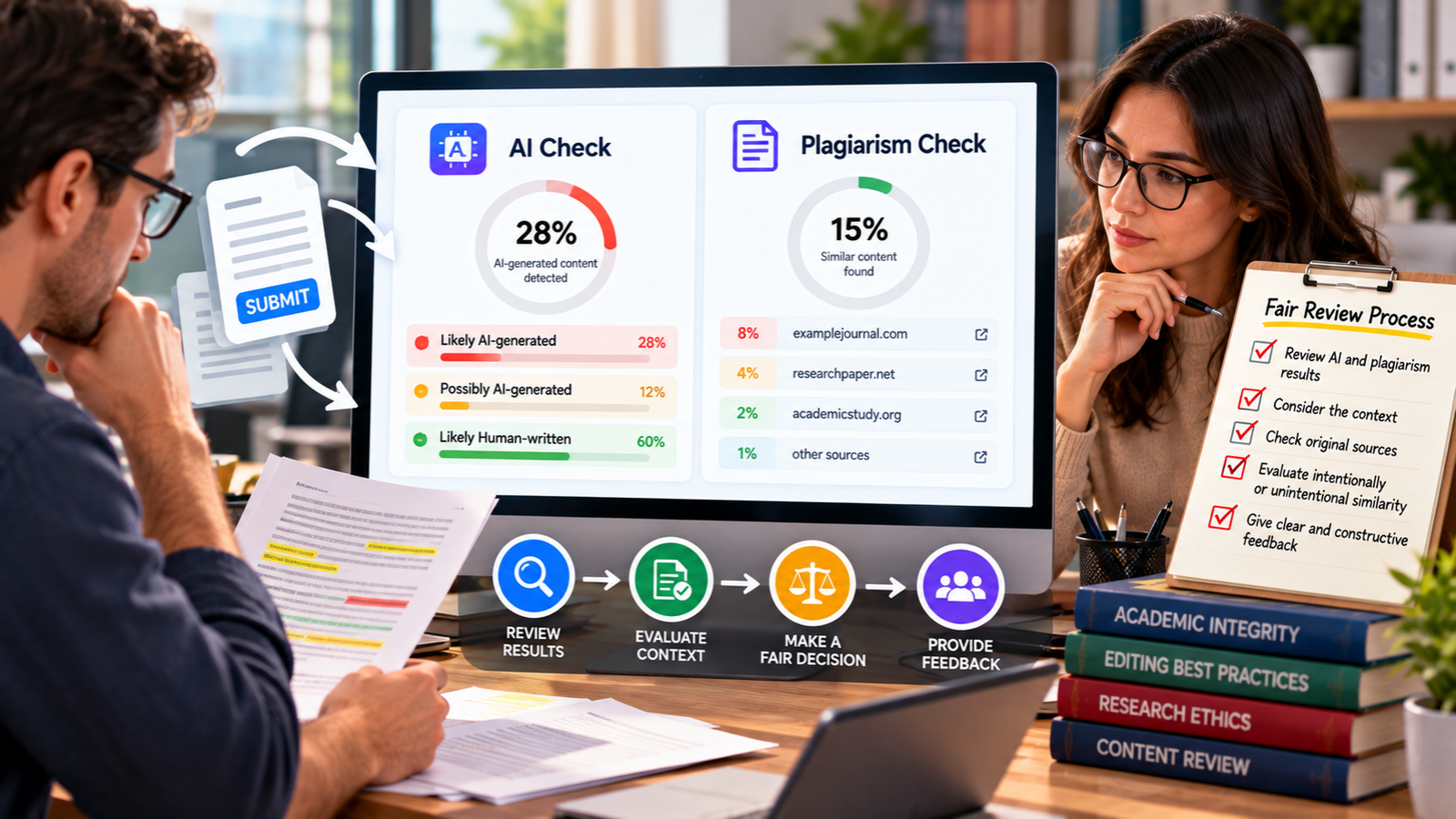
An AI detector is built to estimate whether text contains patterns commonly associated with content produced by generative language models. These tools have become common in schools, publishing teams, recruiting workflows, and content operations. Yet detection is probabilistic, not a direct observation of the writer. The best results come from treating an AI detector as one signal inside a broader review process.
What AI detectors actually measure
AI detectors typically analyze linguistic regularities such as predictability, phrase distribution, sentence rhythm, and stylistic consistency. Some systems also consider document-level patterns and compare passages against learned examples. The exact features and models differ, which explains why detector outputs are not always consistent. A percentage or label should therefore be understood as an estimate produced by a model, not a laboratory measurement of authorship.
Why false positives and false negatives matter
A detector can flag human writing or miss AI-assisted writing. Formulaic language, highly edited prose, short text, non-native writing patterns, and mixed human-AI workflows can all complicate classification. Research has also highlighted challenges with AI-polished writing, where lightly edited human text may still resemble generated prose. That uncertainty matters most when a result is used to accuse someone of misconduct. A responsible process gives the subject an opportunity to provide context and supporting evidence.
How educators and publishers can use results
Schools and publishers can use an AI detector to identify material that deserves a closer look, but the detector should not replace human review. Drafts, outlines, version histories, citations, interviews, and conversations about the work can provide context that a classifier cannot see. A good policy should also explain what the score means and what it does not mean. This reduces the chance that users mistake a probabilistic indicator for proof.
When AI detection should be combined with fact checking
Detection and truth verification solve separate problems. A text could be human-authored yet contain invented sources or unsupported claims. Conversely, a generated draft may contain accurate information if its claims are checked against reliable sources. Pairing an AI detector with a fact checker online can help reviewers address both dimensions: “Where might this text have come from?” and “Are its important claims supported?”
A better interpretation framework
Instead of asking whether the detector is right or wrong, ask what evidence the result adds to the case. Consider the confidence level, the amount of text analyzed, the context of use, and whether independent evidence supports the same conclusion. A mature verification process records the detector output, then documents why a reviewer accepted, discounted, or investigated it further. This turns a black-box score into a transparent decision process.
When an AI detector result needs a closer look
Results deserve extra review when the document is short, heavily edited, highly formulaic, translated, or produced through a mixed human-AI workflow. In these situations, a detector may have fewer reliable signals. A reviewer should compare the result with the document history and the purpose of the content rather than assuming the model has identified the writer.
Practical takeaway
The most useful question is not “What percentage did the detector give?” but “What additional evidence should I examine?” That framing turns AI detection into a practical screening step and supports more careful decisions.
Conclusion
For everyday use, the most useful result is one that helps a reader understand what to check next. When using ai detector in a real workflow, keep the original material available, preserve the date of the check, and separate facts from interpretation. For source-based questions, prioritize documents, direct statements, original recordings, reputable reporting, and other evidence that can be inspected. For AI or plagiarism questions, remember that a detection signal answers a narrower question than factual verification. For social media and news, compare the exact wording of the claim with what the underlying source actually says. If evidence conflicts, document the conflict instead of hiding it. If evidence is missing, use an uncertain status rather than inventing confidence. This approach makes ai detector more than a one-click answer: it becomes part of a transparent verification process that readers, editors, teachers, and content teams can understand and repeat. The ultimate goal is not simply to produce a verdict. It is to reduce avoidable errors, slow the spread of unsupported claims, and help people make decisions using evidence that is clear, traceable, and appropriate to the situation.
Frequently Asked Questions
Should an AI detector be the only basis for discipline?
No. Because detector outputs can be uncertain, consequential decisions should consider multiple forms of evidence.
Do different AI detectors always agree?
No. Different models and thresholds can produce different classifications for the same passage, especially in borderline cases.